stanford/aloha · spec sheet
Stanford ALOHA specs
Low-cost open-source bimanual teleoperation system with two leader and two follower arms plus four cameras, used to collect data for ACT imitation learning.
Media
3 items · credited and licensed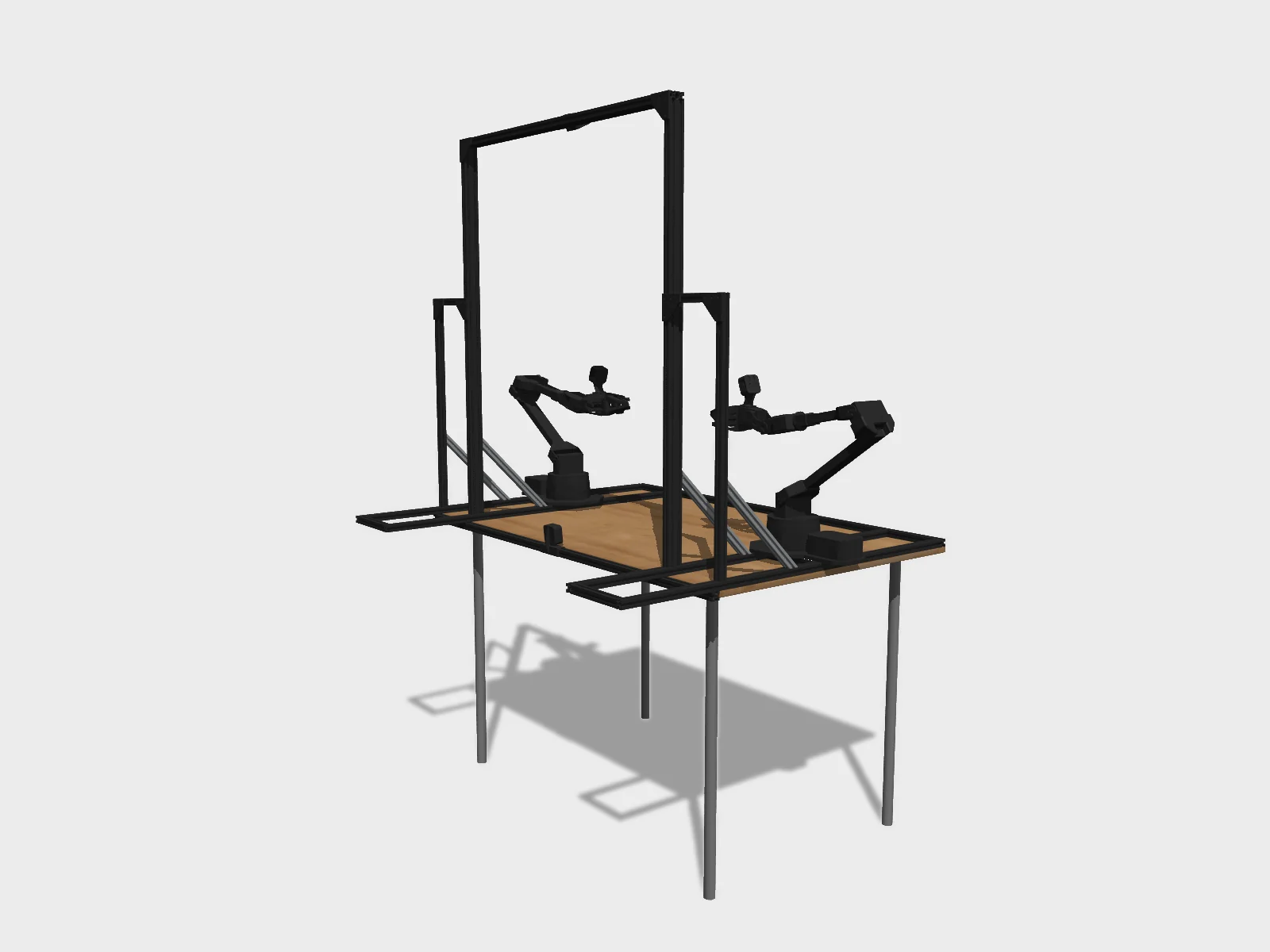 render
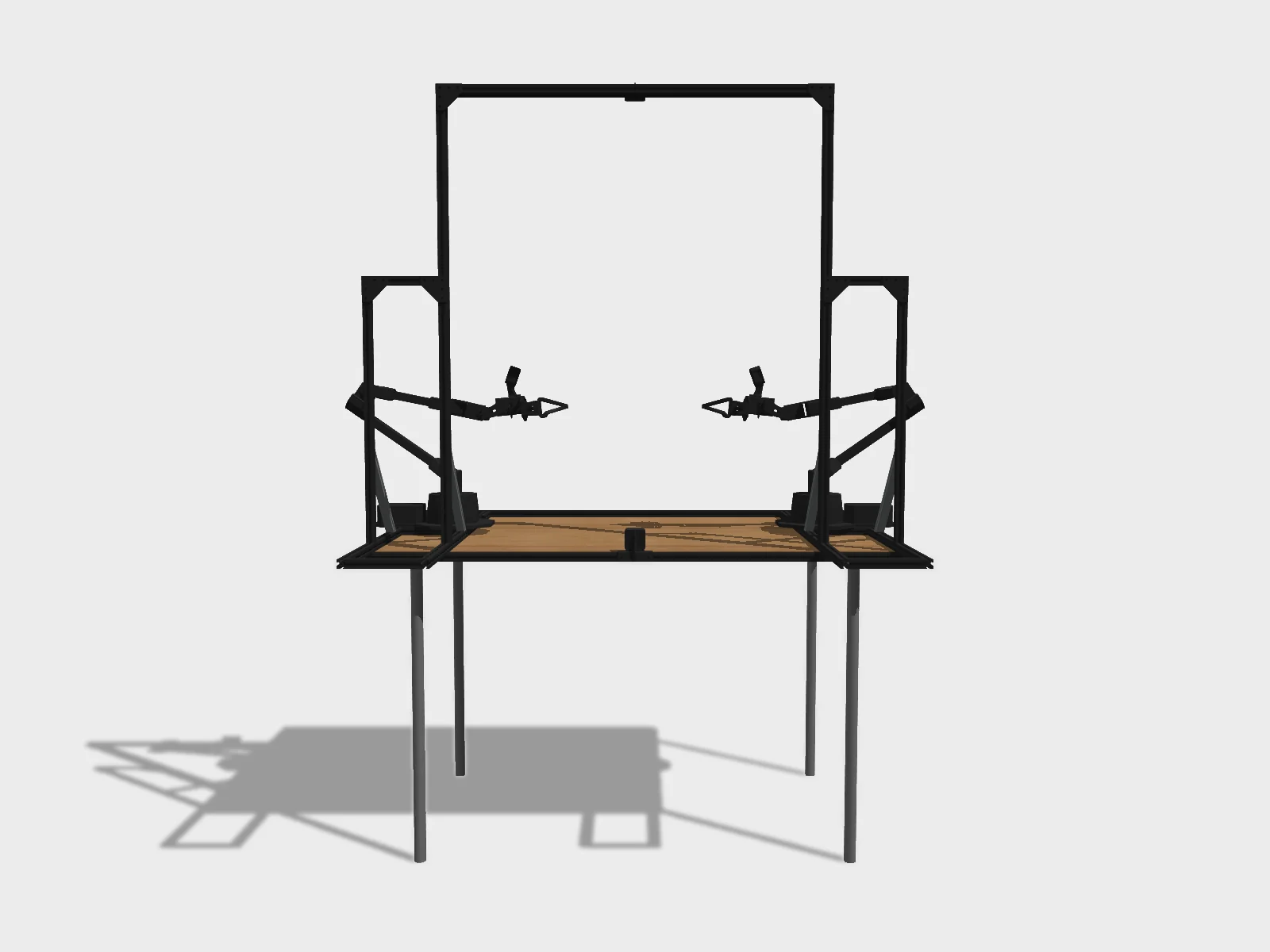 render
Specifications
2/12 fields sourced| Heightspecs.heightCm | unsourced |
|---|---|
| Massspecs.massKg | unsourced |
| Degrees of freedomspecs.dof | unsourced |
| Payloadspecs.payloadKg | unsourced |
| Top speedspecs.speedMps | unsourced |
| Runtimespecs.runtimeMin | unsourced |
| Battery capacityspecs.batteryWh | unsourced |
| Pricespecs.priceUsd | unsourced |
| Actuatorsspecs.actuators | unsourced |
| Computespecs.compute | unsourced |
| Sensorsspecs.sensors | 4 cameras |
| Year introducedyear | 2023 |
| Licenselicense.hw / .sw / .docs | Software: MIT |
Note · Original repo last pushed Apr 2024; follow-ons (ALOHA 2, commercial kits) exist. Hardware assembly guide is a Google Doc. MIT covers the aloha and act code only; the hardware (Trossen arms) is sold under Trossen's terms and the printed parts have no stated license, so hw is left undeclared.
| Artifact | Public | Weight | Points |
|---|---|---|---|
| CADopenness.cad | yes | 25 | 25 |
| Bill of materialsopenness.bom | yes | 20 | 20 |
| Sim model (URDF/MJCF)openness.sim | yes | 20 | 20 |
| Firmwareopenness.firmware | no | 15 | 0 |
| Softwareopenness.software | yes | 10 | 10 |
| Trained policiesopenness.policies | yes | 10 | 10 |
| score = Σ weight × public | 85 | ||
BOM by category · USD from priced lines
| Category | Lines | Qty | USD |
|---|---|---|---|
| Actuators | 2 | 4 | 17,984 |
| Structure | 7 | 8 | 507 |
| Sensors | 1 | 4 | 393 |
| Fasteners | 7 | 12 | 210 |
| Other | 11 | 14 | 155 |
| Electronics | 1 | 2 | 40 |
| Cabling | 3 | 9 | — |
| Power | 1 | 1 | — |
| Compute | 1 | 1 | — |
Offers in US from 2 vendors
Subsystems · assembly groups
| Group | Steps | Min | Safety |
|---|---|---|---|
| Fabrication | 1 | — | — |
| Electrical | 2 | — | 2 |
| Software | 2 | — | — |
| Master arms (WidowX) | 6 | — | 1 |
| Puppet arms (ViperX) | 3 | — | — |
| Frame | 5 | — | 1 |
| Bring-up | 2 | — | 1 |
| Data | 1 | — | — |
| Policy | 1 | — | — |
Fabrication: FDM print ×11
Firmware
- Targets
- Interbotix X-series arms: stock Dynamixel firmware (gripper motor ID 9 is XM430-W350 on the ViperX), Robot USB interface (FTDI serial; udev bound to /dev/ttyDXL_*)
- Repo
- github.com/Interbotix/interbotix_ros_manipulators
- Calibrate
- No joint calibration step upstream. Set Dynamixel Wizard to Protocol 2.0 / 1,000,000 bps, set puppet gripper (ID 9) Current Limit to 200, and adjust the gripper open/close constants in aloha_scripts/constants.py (MASTER_/PUPPET_GRIPPER_POSITION_* and _JOINT_*) if your printed fingers differ.
- Notes
- Stock servo firmware; control runs through the Interbotix ROS driver (`interbotix_xsarm_control`, robot_model wx250s for masters and vx300s for puppets) launched by `4arms_teleop.launch` with per-arm mode configs in `config/`.
Policies
- Bimanual cube transfer (simulation, human demos) · LeRobot ACT · huggingface.coTrained in the gym-aloha MuJoCo sim on lerobot/aloha_sim_transfer_cube_human; not a real-robot checkpoint. Apache-2.0.
- Bimanual peg insertion (simulation, human demos) · LeRobot ACT · huggingface.coSimulation only; not a real-robot checkpoint. Apache-2.0.
Caveats · stated by the package
- The ViperX 300 6DOF and WidowX 250 6DOF links in the tutorial BOM now redirect to Trossen's /ai page, and Trossen's ViperX 300 S and WidowX 250 S pages are marked discontinued. Trossen now sells ALOHA as kits (Stationary, Mobile, Solo) built on newer hardware; this package describes the original ALOHA only.
- USD prices are the tutorial's 2023 figures. The listed total ($19,529.03) does not equal the sum of the line items; the robots are about $18,000 of it.
- The replacement power supply, DC cables, spade connectors and 10 ft USB cables have links but no prices; the fork spade connector quantity is not stated. The printer is only '~$300'.
- All non-robot vendor links are Amazon US short links (a.co); there are no EU/CN/IN sources upstream.
- OS guidance conflicts: the README lists Ubuntu 18.04/20.04 with ROS 1 Noetic as tested, while the tutorial's Codebase section says Ubuntu 22.04 with ROS 2 Humble. The repo's launch files and scripts are ROS 1.
- The README's arm.py patch (T_sb = None) edits Interbotix toolbox code and must be redone after Interbotix updates.
- Print settings give no layer height or exact wall counts; those are in images in the printing doc. STLs live in a Google Drive folder, not the repo. The repo's aloha2/ folder holds ALOHA 2 parts (wrist cam mount, gravity compensator clips, D405 mounts, workcell) that are out of scope here.
- No real-robot policies are published. The Hugging Face ACT checkpoints are trained in simulation.
- Arms collapse when torque is turned off (no brakes); support them when using Dynamixel Wizard.
- Robot hardware is sold by Trossen under its own terms; the aloha and act code is MIT.
Package stanford/aloha@0.1.0 · upstream tonyzhaozh/aloha@06369f03cd8e0a47e16d3a90167853fd33af7557 (2024-04-19); tonyzhaozh/act@742c753c0d4a5d87076c8f69e5628c79a8cc5488 (2024-01-28); ALOHA Hardware Assembly Tutorial (Google Doc, change log through May 23) and 3D Printing Instructions doc as of 2026-09-25; Hugging Face lerobot/act_aloha_sim_* (last modified 2025-03-06) · 13 package sources
Models, repositories, links
7 links- MJCFgithub.com/google-deepmind/mujoco_menagerie/tree/main/alohamodel
- Menageriemujoco_menagerie/alohamodel
- Repogithub.com/tonyzhaozh/alohagithub.com
- Repogithub.com/tonyzhaozh/actgithub.com
- Sitetonyzhaozh.github.io/aloha/tonyzhaozh.github.io
- Docsgithub.com/tonyzhaozh/alohagithub.com
- Buytrossenrobotics.com/aloha-kitstrossenrobotics.com
Videos
1 tagged · 0 from the maker's channelNews and papers
0 stories · 0 papersNews mentioning ALOHA
Papers using ALOHA
20241
- Research
Stanford publishes Mobile ALOHA
Mobile ALOHA put the ALOHA teleoperation setup on a mobile base for low-cost, whole-body data collection and imitation learning.
Stanford UniversityStanford ALOHAarxiv.orgventurebeat.com
20231
- Research
ALOHA and ACT paper released
Stanford-led researchers introduced ALOHA, a low-cost open bimanual teleoperation system, and the Action Chunking with Transformers (ACT) imitation-learning method.
Stanford UniversityStanford ALOHAarxiv.org
Sources
last checked 2026-09-25- [1]ALOHA repo (MIT)github.com/tonyzhaozh/alohachecked 2026-09-24
- [2]Project sitetonyzhaozh.github.io/aloha/checked 2026-09-24
- [3]MuJoCo Menagerie alohagithub.com/google-deepmind/mujoco_menagerie/tree/main/alohachecked 2026-09-24
- [4]Trossen Robotics ALOHA kitstrossenrobotics.com/aloha-kitschecked 2026-09-25
- [5]Trossen ViperX 300 page (marked discontinued)trossenrobotics.com/viperx-300checked 2026-09-25
- [6]LeRobot ACT ALOHA checkpoint (trained in sim)huggingface.co/lerobot/act_aloha_sim_transfer_cube_humanchecked 2026-09-25
Suggest a correction
Related
Nearest by size (height, mass)
Also by Stanford (Tony Zhao et al.)
Cite this page
humanoidrobots.systems. “Stanford ALOHA specs.” Hyperspawn, data revision 2026-10-08. https://humanoidrobots.systems/stanford/aloha
Machine-readable: /data.json (record stanford/aloha).